
What is a DIFC Variable Capital Company? A DIFC Variable Capital Company (VCC) is a private company structure in the Dubai International Financial Centre that links share capital to Net Asset Value, allowing family offices and investors to hold and segregate multiple asset classes under one umbrella entity.
As family offices, investors, entrepreneurs and business owners build increasingly diverse portfolios across multiple asset classes and jurisdictions, traditional ownership structures are not always the most efficient solution.
Historically, separate holding companies would often be established to hold different investments, businesses, real estate portfolios, or co-investment arrangements. While this approach can provide legal separation, it can also create additional governance, administration, compliance and reporting requirements.
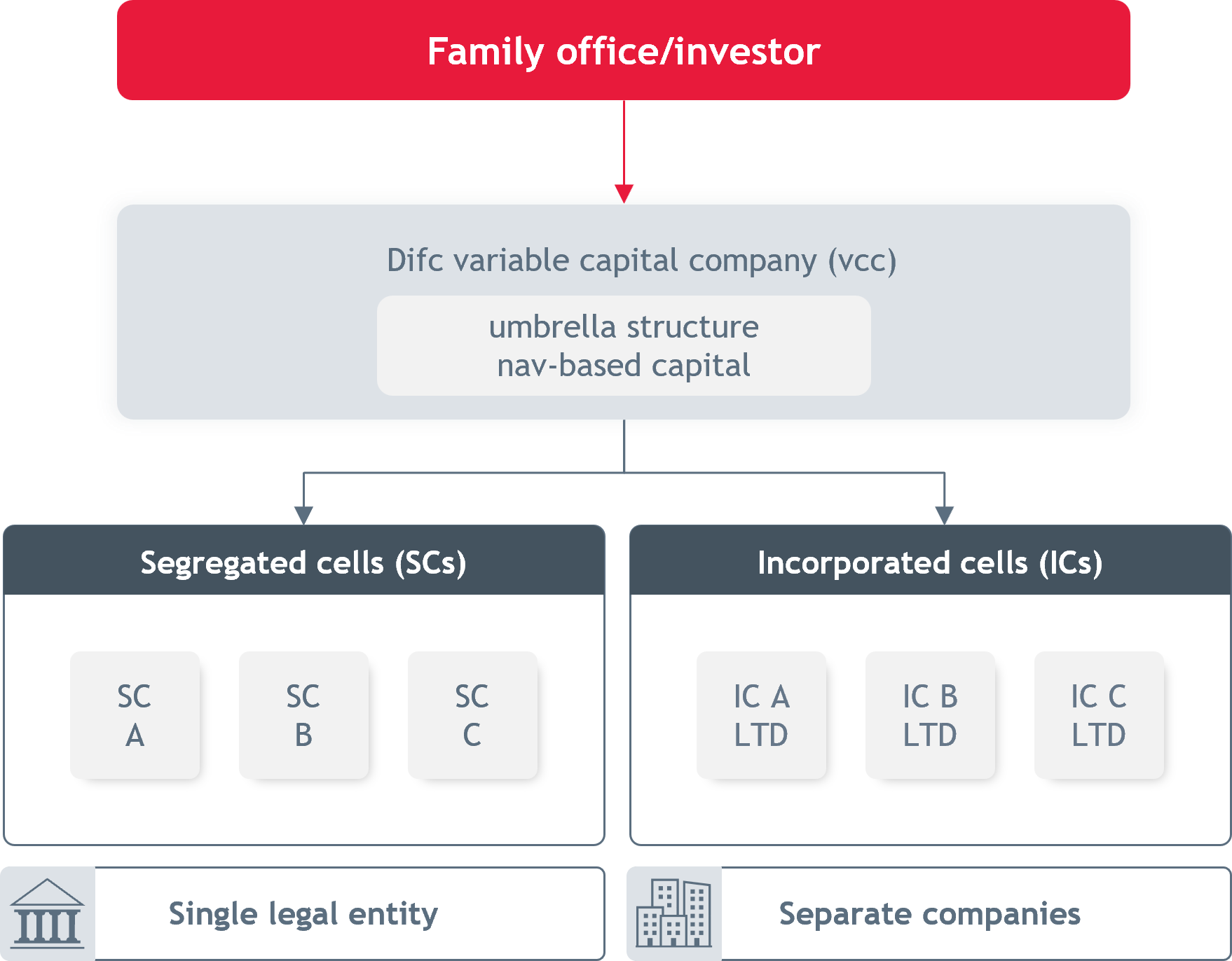
To address these evolving needs, the Dubai International Financial Centre (DIFC) introduced the Variable Capital Company (VCC), a flexible asset holding and investment structuring vehicle that offers a modern alternative to traditional holding company structures. Unlike a conventional company, where share capital is generally fixed, a VCC operates using a variable capital model linked to the Net Asset Value (NAV) of its underlying assets, providing significantly greater flexibility for investors and wealth structures.
The DIFC VCC adds another important component to the DIFC's growing private wealth and investment ecosystem and creates new opportunities for family offices, investment platforms, real estate investors and business owners seeking scalable and efficient ownership solutions.
Another distinguishing feature is that distributions may be made by reference to NAV rather than solely from accumulated profits, offering greater flexibility than many traditional holding company structures.
A VCC can be established either:
Segregated Cells form part of the VCC and do not create separate legal entities.
Key characteristics include:
Incorporated Cells operate differently.
Each Incorporated Cell:
In this scenario, the ultimate ownership remains with a single family.
The objective is to ring-fence different asset classes while maintaining centralised governance, administration and reporting. Segregated Cells provide a practical solution without creating multiple separate companies.
Each investment has a different investor group and potentially a different investment strategy.
Incorporated Cells provide legal separation, distinct ownership arrangements and the ability to separate or sell individual portfolios without affecting the overall platform.
Different business lines may require distinct shareholders, management teams, financing arrangements, or future exit strategies.
The ability to spin-off an Incorporated Cell into an independent company can be particularly valuable for acquisitions, divestments, or strategic partnerships.
With the growing adoption of DIFC Foundations, many families and investors may ask whether a Foundation or a VCC is the more appropriate structure.
In reality, the two structures serve different purposes and are often complementary rather than competing solutions.
A DIFC Foundation primarily focuses on:
This layered approach can help families achieve governance, continuity, succession planning and asset segregation within a single integrated structure.
Key advantages of the DIFC VCC:
CONNECT WITH US
As family offices, investors, entrepreneurs and business owners build increasingly diverse portfolios across multiple asset classes and jurisdictions, traditional ownership structures are not always the most efficient solution.
Historically, separate holding companies would often be established to hold different investments, businesses, real estate portfolios, or co-investment arrangements. While this approach can provide legal separation, it can also create additional governance, administration, compliance and reporting requirements.
To address these evolving needs, the Dubai International Financial Centre (DIFC) introduced the Variable Capital Company (VCC), a flexible asset holding and investment structuring vehicle that offers a modern alternative to traditional holding company structures. Unlike a conventional company, where share capital is generally fixed, a VCC operates using a variable capital model linked to the Net Asset Value (NAV) of its underlying assets, providing significantly greater flexibility for investors and wealth structures.
The DIFC VCC adds another important component to the DIFC's growing private wealth and investment ecosystem and creates new opportunities for family offices, investment platforms, real estate investors and business owners seeking scalable and efficient ownership solutions.
VCC share capital and NAV explained
Unlike traditional companies that operate with a fixed share capital, the share capital of a VCC is linked to its Net Asset Value (NAV). As the value of its underlying assets increases or decreases, the capital position of the VCC adjusts accordingly. Shares may be issued and redeemed based on NAV, creating a structure that more closely reflects the economic value of the underlying portfolio.Another distinguishing feature is that distributions may be made by reference to NAV rather than solely from accumulated profits, offering greater flexibility than many traditional holding company structures.
A VCC can be established either:
- As a standalone VCC without any cells
- As an umbrella structure with Segregated Cells (SCs)
- As an umbrella structure with Incorporated Cells (ICs)
Key benefits of a VCC
- NAV-based variable capital structure
- Ability to issue and redeem shares based on underlying asset values
- Distributions may be made by reference to capital and NAV, not solely retained profits
- Segregation of assets and liabilities
- Ability to accommodate different investor groups
- Centralised administration under a single umbrella structure
- Scalable and cost-effective ownership platform
- Suitable for family offices, investment structures and asset holding arrangements
Regulatory considerations
While a VCC offers features commonly associated with investment structures, it is primarily intended as a private asset holding and structuring vehicle. Unless specifically authorised by the DFSA, a VCC cannot be used to conduct regulated financial services activities or establish a fund. It also remains subject to applicable securities laws and restrictions on public offerings. As such, VCCs are generally best suited for proprietary investment, family office, asset holding and wealth structuring arrangements rather than regulated investment activities.Understanding the umbrella structure
A VCC may establish either Segregated Cells or Incorporated Cells, but not both simultaneously.
Segregated Cells (SCs)
Segregated Cells form part of the VCC and do not create separate legal entities.Key characteristics include:
- One overall legal entity
- Separate pools of assets and liabilities
- Different cell shareholders may participate in different cells
- Cell shares may be issued to different investor groups
- Centralised governance and board structure
- Lower administrative complexity
Incorporated Cells (ICs)
Incorporated Cells operate differently.Each Incorporated Cell:
- Is a separate legal entity
- Can have its own shareholders
- Can have its own board of directors
- Maintains separate assets and liabilities
- May be converted into an independent company in the future
Key considerations: Segregated Cells vs Incorporated Cells
| Feature | Segregated Cell (SC) | Incorporated Cell (IC) |
| Legal status | Part of VCC | Separate legal entity |
| Shareholders | Different cell shareholders possible | Own shareholders |
| Board | VCC level | Own board possible |
| Asset separation | Ring-fenced | Ring-fenced |
| Administration | Simpler | More flexibility |
| Future spin-off | No | Yes |
Illustrative VCC Structure
Practical applications and structuring examples
The flexibility of the VCC allows it to be adapted to a wide range of investment and ownership objectives.
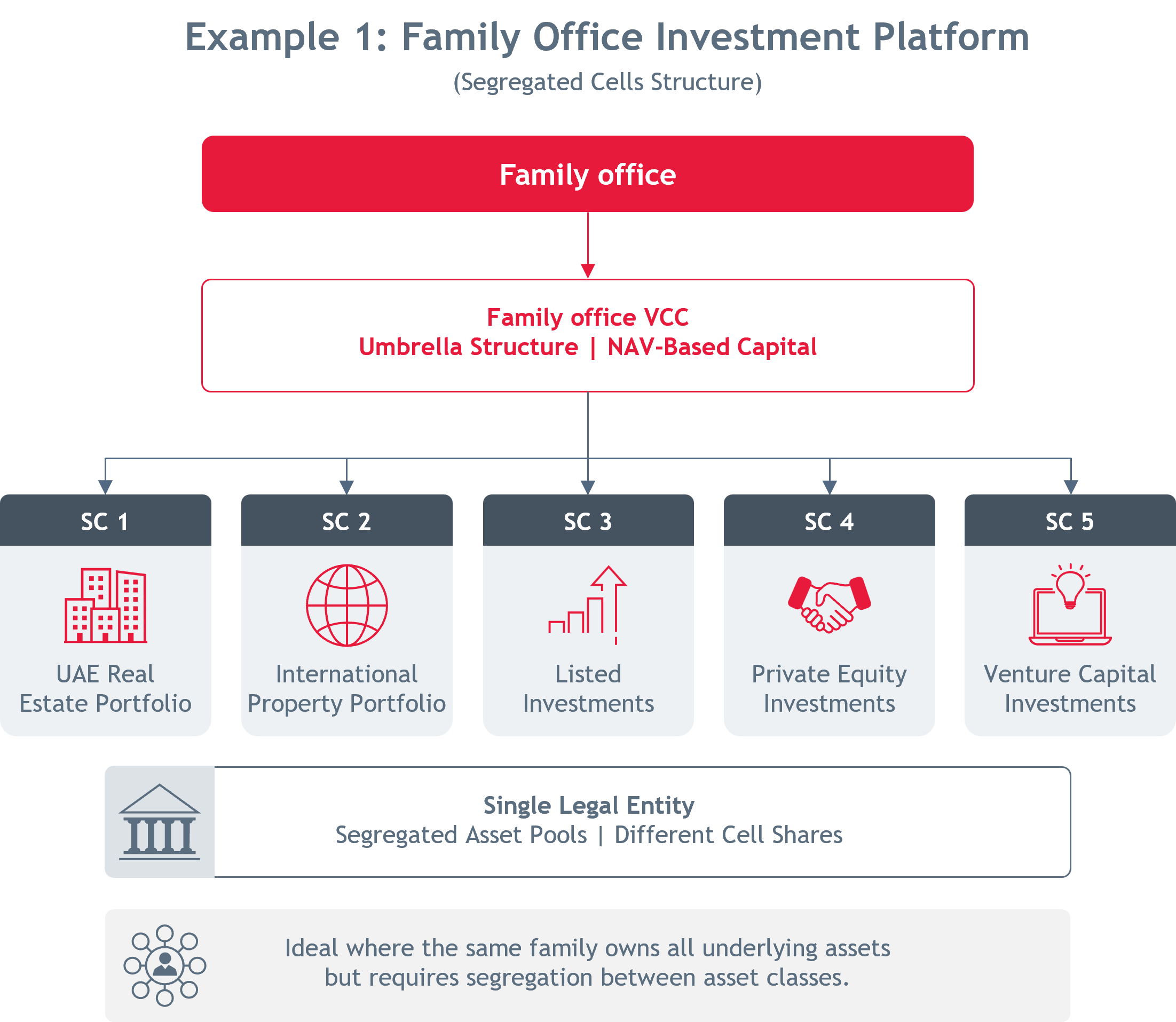
Example 1: family office investment platform structure
Why Segregated Cells?
In this scenario, the ultimate ownership remains with a single family.The objective is to ring-fence different asset classes while maintaining centralised governance, administration and reporting. Segregated Cells provide a practical solution without creating multiple separate companies.
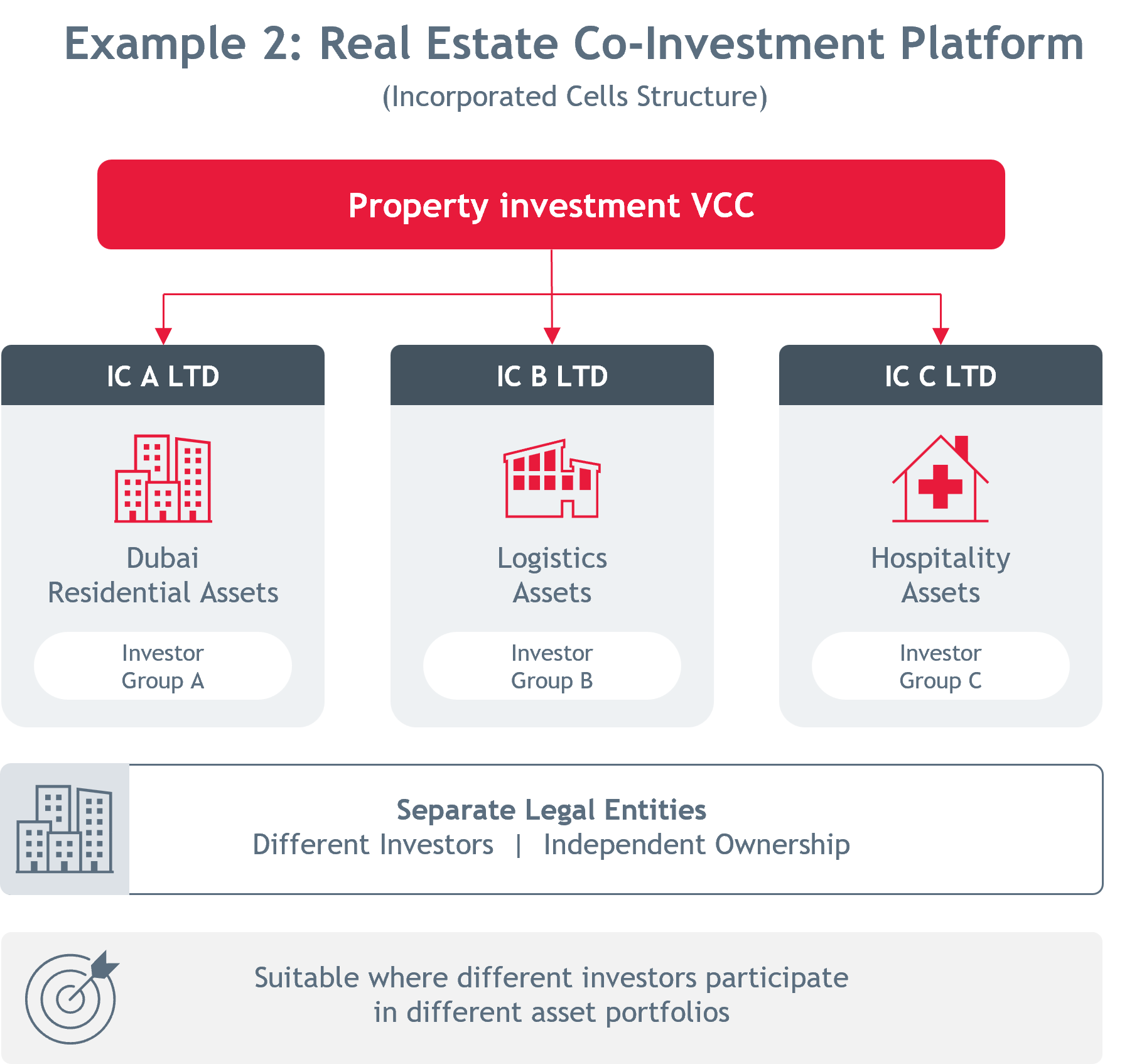
Example 2: real estate co-investment platform structure
Why Incorporated Cells?
Each investment has a different investor group and potentially a different investment strategy.Incorporated Cells provide legal separation, distinct ownership arrangements and the ability to separate or sell individual portfolios without affecting the overall platform.
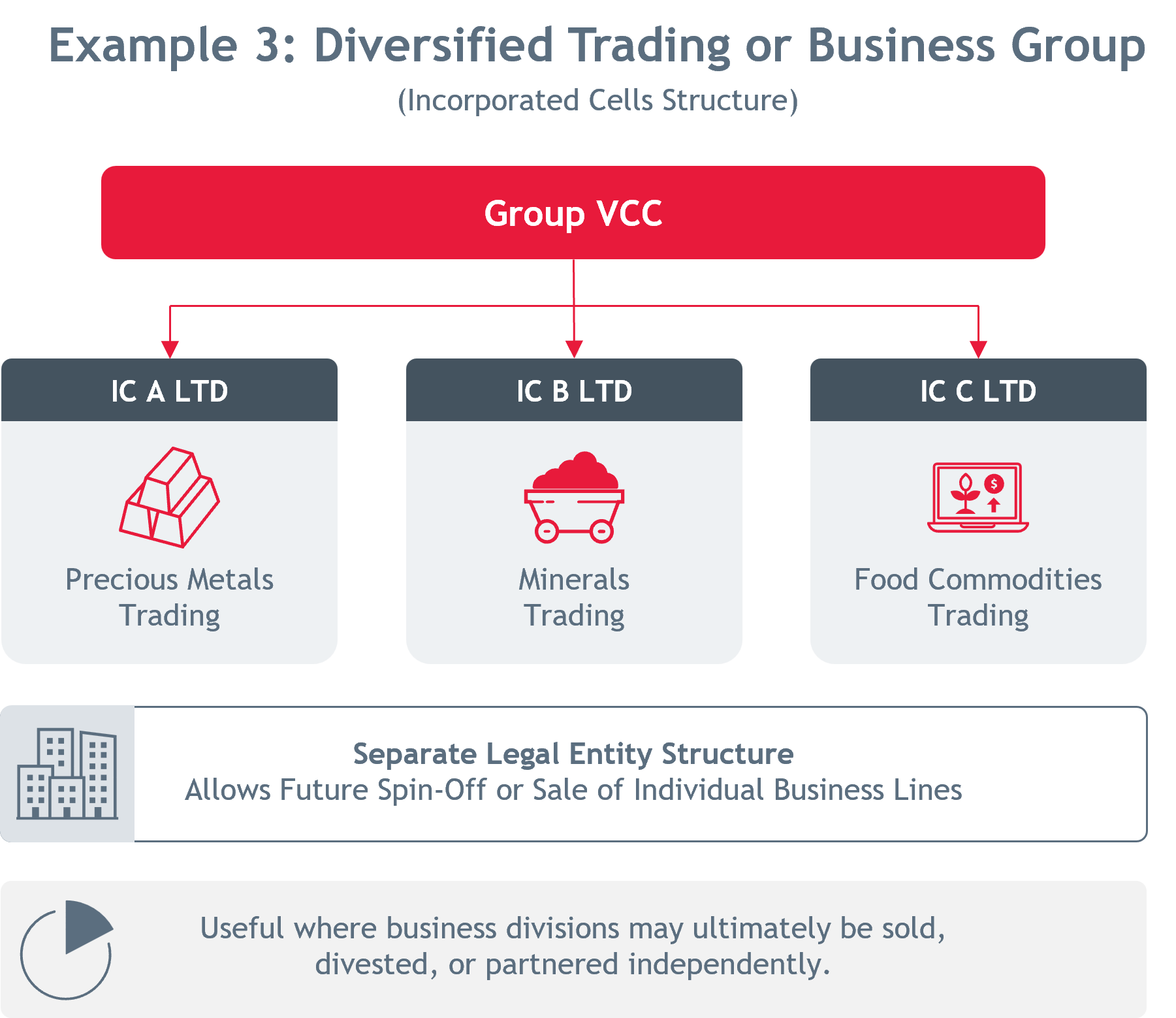
Example 3: diversified trading or business group structure
Why Incorporated Cells?
Different business lines may require distinct shareholders, management teams, financing arrangements, or future exit strategies.The ability to spin-off an Incorporated Cell into an independent company can be particularly valuable for acquisitions, divestments, or strategic partnerships.
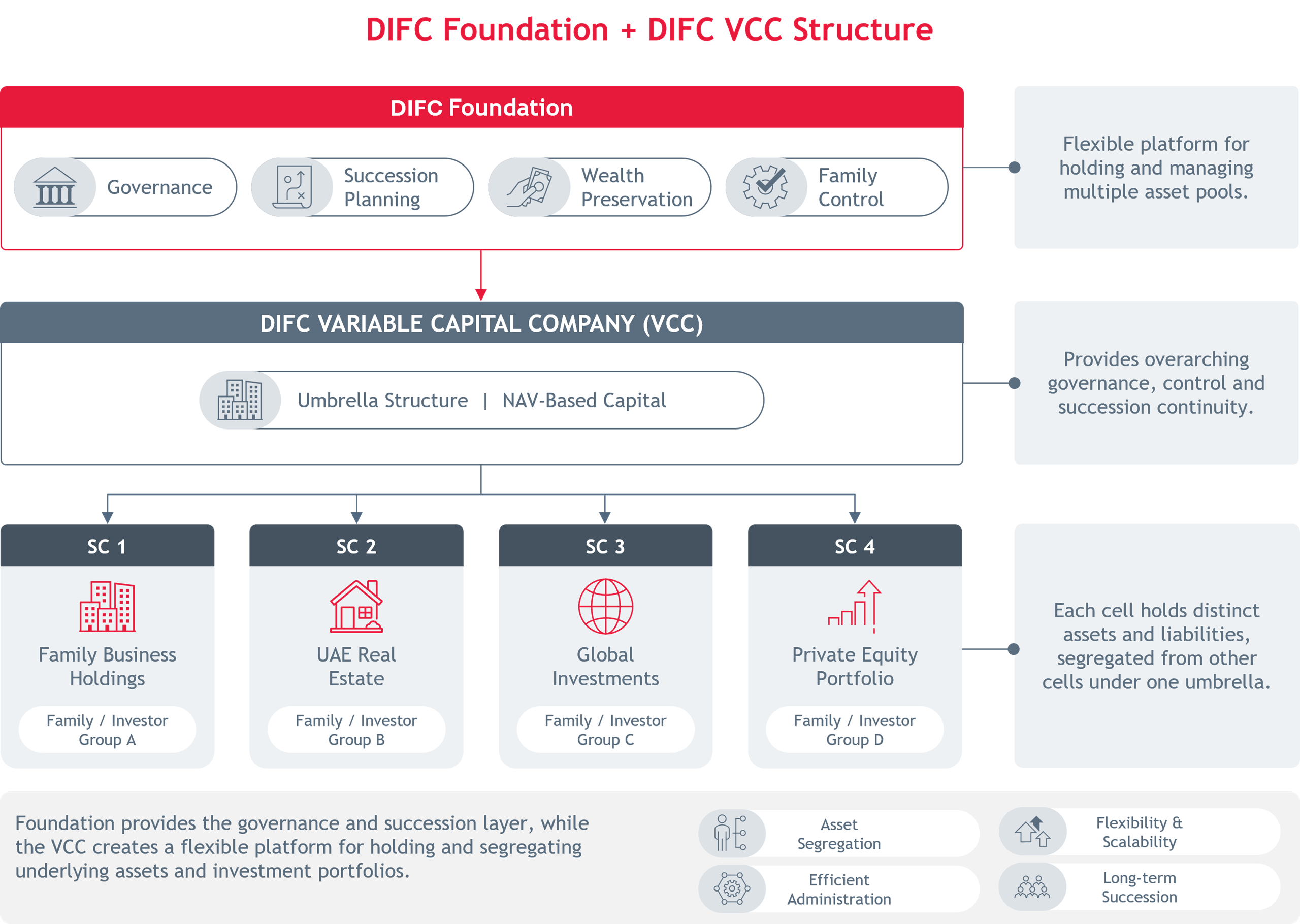
DIFC Foundation vs DIFC VCC: how the two structures work together
With the growing adoption of DIFC Foundations, many families and investors may ask whether a Foundation or a VCC is the more appropriate structure.In reality, the two structures serve different purposes and are often complementary rather than competing solutions.
A DIFC Foundation primarily focuses on:
- Succession planning
- Family governance
- Wealth preservation
- Ownership continuity
- Legacy planning
- Asset holding
- Investment structuring
- Portfolio segregation
- Investor participation
- Asset management flexibility
Example Structure
Conclusion: is a DIFC VCC right for your structure?
The DIFC Variable Capital Company gives family offices, investors and business owners a single scalable platform for holding and segregating diverse assets, without the cost and complexity of multiple standalone companies.Key advantages of the DIFC VCC:
- NAV-linked capital – share capital and distributions track the underlying portfolio's Net Asset Value, rather than being fixed or profit-only
- Segregated or Incorporated Cells – ring-fence asset classes or investor groups under one umbrella, with the option to spin off an Incorporated Cell as an independent company later
- Centralised governance – one administrative and reporting structure covers multiple cells, reducing overhead compared with separate holding companies
- Complementary to DIFC Foundations – a Foundation can provide succession and governance while the VCC handles asset holding, giving families a single integrated structure for both
CONNECT WITH US