

Background – UAE Corporate Tax Regime and the Evolving Free Zone Landscape
The United Arab Emirates (“UAE”) has long established itself as a leading global investment hub, underpinned by its strategic geographic location, stable political environment, and business-friendly regulatory framework. Historically, the UAE operated a predominantly tax-neutral regime, with no federal corporate income tax imposed on most business activities—other than specific sectors such as oil and gas, and branches of foreign banks. This low-tax environment has been instrumental in attracting multinational groups, investment platforms, family offices, financial institutions, and regional headquarters, particularly within the UAE’s well-developed Free Zones and international financial centres, including the Dubai International Financial Centre (“DIFC”).
In line with evolving global tax standards and the Organisation for Economic Co-operation and Development’s (“OECD”) Base Erosion and Profit Shifting (“BEPS”) initiative, the UAE has since introduced a federal Corporate Tax (“CT”) framework. This was enacted through Federal Decree-Law No. 47 of 2022 on the Taxation of Corporations and Businesses (“UAE CT Law”), marking a significant shift in the country’s tax landscape. The UAE CT regime became effective for financial years commencing on or after 1 June 2023, aligning UAE with international tax best practices while maintaining its overall competitiveness as a global business destination.
The introduction of Corporate Tax represents a significant transformation in the UAE’s fiscal landscape. However, the regime has been carefully designed to preserve the UAE’s attractiveness as a leading global business and investment hub, while aligning with internationally accepted tax standards.
Under the UAE CT regime, taxable persons are subject to Corporate Tax at the following rates:
Free Zones continue to play a central role within the UAE economy. Recognising their importance, the UAE CT Law preserves a preferential tax regime for eligible Free Zone entities that satisfy prescribed conditions.
A Free Zone entity may qualify as a Qualifying Free Zone Person (“QFZP”) and benefit from:
To qualify as a QFZP, a Free Zone Person must, among other conditions:
In line with evolving global tax standards and the Organisation for Economic Co-operation and Development’s (“OECD”) Base Erosion and Profit Shifting (“BEPS”) initiative, the UAE has since introduced a federal Corporate Tax (“CT”) framework. This was enacted through Federal Decree-Law No. 47 of 2022 on the Taxation of Corporations and Businesses (“UAE CT Law”), marking a significant shift in the country’s tax landscape. The UAE CT regime became effective for financial years commencing on or after 1 June 2023, aligning UAE with international tax best practices while maintaining its overall competitiveness as a global business destination.
The introduction of Corporate Tax represents a significant transformation in the UAE’s fiscal landscape. However, the regime has been carefully designed to preserve the UAE’s attractiveness as a leading global business and investment hub, while aligning with internationally accepted tax standards.
Overview of the UAE Corporate Tax Regime
Under the UAE CT regime, taxable persons are subject to Corporate Tax at the following rates:
- 0% on taxable income up to AED 375,000; and
- 9% on taxable income exceeding AED 375,000.
- UAE incorporated entities;
- Natural persons conducting business or business activities where revenue exceeds AED 1 million;
- Foreign entities effectively managed and controlled in the UAE; and
- Foreign juridical persons deriving income through a Permanent Establishment or nexus in the UAE.
Free Zones and the UAE’s Competitive Tax Framework
Free Zones continue to play a central role within the UAE economy. Recognising their importance, the UAE CT Law preserves a preferential tax regime for eligible Free Zone entities that satisfy prescribed conditions.A Free Zone entity may qualify as a Qualifying Free Zone Person (“QFZP”) and benefit from:
- 0% Corporate Tax on “Qualifying Income”; and
- 9% Corporate Tax on its Taxable Income that is not Qualifying Income.
To qualify as a QFZP, a Free Zone Person must, among other conditions:
- Derive Qualifying Income*
- Non-qualifying Revenue must meet the de minimis threshold (5% of total revenue or AED 5 million, whichever is lower)
- Maintain adequate economic substance in the Free Zone;
- Comply with transfer pricing requirements;
- Maintain audited financial statements; and
- Not have elected to ‘opt out’ of the preferential free zone regime
- Transactions (other than Excluded Activities) with other Free Zone Person provided the other Free Zone Person is the beneficial recipient of such services or goods.
- Transaction with a Non-Free Zone Person with respect to activities which fall under the list of Qualifying Activities:
- Manufacturing of goods or materials.
- Processing of goods or materials.
- Trading of Qualifying Commodities.
- Holding of shares and other securities for investment purposes.
- Ownership, management and operation of Ships.
- Reinsurance services.
- Fund management services.
- Wealth and investment management services.
- Headquarter services to Related Parties.
- Treasury and financing services to Related Parties or for its own account.
- Financing and leasing of Aircrafts.
- Distribution of goods or materials in or from a Designated Zone.
- Logistics services.
- Excluded and Non-Qualifying Activities subject to de minimis threshold mentioned above.
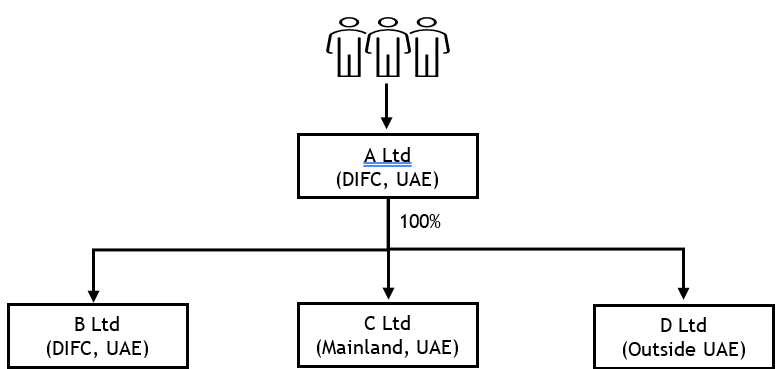
Case Study 1 : Holding Company Structure
Background:
A group of foreign investors has established A Ltd in the DIFC Free Zone, which is a DIFC Prescribed Company, a passive holding and structuring vehicle established under the DIFC Prescribed Company Regulations with a licensed activity of "Holding Company", to centrally own and manage its investments across the UAE and overseas jurisdictions. Instead of holding investments directly in multiple countries, the group has structured its regional investments through A Ltd.Under the structure, A Ltd holds 100% shares in:
- B Ltd – incorporated in DIFC, UAE
- C Ltd – incorporated in Mainland UAE
- D Ltd – incorporated outside the UAE
UAE Corporate Tax Implications
Free Zone Relief for Holding Companies
Under the UAE Corporate Tax regime, the holding of shares and other securities for investment purposes is treated as a Qualifying Activity for a QFZP. As such, income earned from such investments, including dividend income and capital gains, may qualify for the 0% Free Zone Corporate Tax rate, subject to satisfaction of the prescribed conditions.Shares or securities will be regarded as held for investment purposes where either of the following conditions is satisfied:
a) the shares or securities are held for an uninterrupted period of at least 12 months; or
b) the QFZP intends to hold the shares or securities for an uninterrupted period of at least 12 months and can demonstrate such intention with appropriate supporting evidence.
As such, in the present case, A Ltd’s investment in B Ltd (being a Free Zone entity) may qualify as qualifying income, provided B Ltd is the beneficial recipient. Further, income derived from investments in C Ltd and D Ltd may also qualify as qualifying income, subject to satisfaction of the above-mentioned investment holding conditions.
Adequate Substance Requirement
Considering one of the conditions to be considered as QFZP is to maintain adequate economic substance in DIFC, A Ltd would be required to maintain adequate assets, full-time employees, and incur an adequate amount of operating expenditures in the Free Zone to perform its core income-generating activities. As a holding company, A Ltd’s core income-generating activity lies in the strategic oversight and investment decision-making undertaken by its Board of Directors.
As such, where Board meetings are held within the DIFC and key investment decisions are made and appropriately documented in DIFC, this may support the position that A Ltd has adequate substance in the Free Zone.
As Prescribed Company explicitly exempt to maintain a physical office space satisfying adequate substance condition under the UAE CT Law become challenging. In such circumstances, engaging a Corporate Service Provider (CSP) to support governance and administrative functions, including the arrangement of Board meetings within the DIFC, may be explored. Alternatively, the use of shared office facilities or co-working arrangements within the DIFC could also be considered.
That said, the extent to which such arrangements may satisfy the adequate substance requirement remains dependent on the specific facts and circumstances and is ultimately subject to the interpretation and guidance of the Federal Tax Authority (“FTA”).
Subject to the above considerations, A Ltd may be regarded as meeting the adequate substance requirement in the DIFC.
Alternative Position if Free Zone Relief is Not Available
In circumstances where A Ltd is not considered as a QFZP i.e. does not qualify for the Free Zone regime, income derived from investments may still qualify as exempt income, subject to fulfillment of the relevant conditions.The tax treatment of investment income earned by A Ltd would generally be as follows:
| Revenue Stream | From B Ltd (DIFC, UAE) | From C Ltd (Mainland, UAE) | From D Ltd (Outside UAE) |
| Dividend Income |
Exempt without any conditions | Exempt without any conditions | Exempt subject to participation exemption conditions |
| Capital Gains / Losses, FX Gains / Losses, Impairment Gains / Losses | Exempt subject to participation exemption conditions | Exempt subject to participation exemption conditions | Exempt subject to participation exemption conditions |
The Participation Exemption under the UAE CT Law regime is a relief mechanism that exempts dividend income, capital gains etc derived from a Participation in another juridical person. The exemption is intended to prevent the same profits from being taxed multiple times as they move through a corporate group and to enhance the UAE's attractiveness as a regional holding company jurisdiction.
Participation Exemption Conditions
The Participation Exemption may be available where the following conditions are satisfied:
- Minimum Ownership Test – The Taxable Person holds at least 5% ownership in the Participation.
- Minimum Acquisition Cost Test – Alternatively, the acquisition cost of the ownership interest is at least AED 4 million.
- Holding Period Test – The Participating Interest is held, or intended to be held, for an uninterrupted period of at least 12 months.
- Subject to Tax Test – The Participation is subject to UAE Corporate Tax or a comparable foreign tax at a rate of at least 9%, subject to certain exclusions.
- Entitlement to Profits and Liquidation Proceeds Test – The ownership interest entitles the holder to at least 5% of the profits and liquidation proceeds of the Participation.
- Asset Test – No more than 50% of the Participation's direct and indirect assets may consist of ownership interests that would not qualify for the Participation Exemption if held directly.
DIFC is home to over 10,000 active registered companies as of H1 2026, reinforcing its position as the leading financial centre in the MEASA region. With the recent expansion of the Prescribed Company regime, it is expected to further increase its attractiveness for investment holding and corporate structuring purposes.
Case Study 2 : Holding + Headquarter Company Structure
Background:
In addition to Case Study 1, the group of foreign investors may establish A Ltd as a Private Company Limited by Shares with a licensed activity of "Managing Office" to act as the Group’s headquarters entity within the DIFC. The management team would oversee and manage the Group’s overall operations and provide services such as management support, administrative and procurement assistance, business planning, and coordination of activities across the Group. A Ltd would also incur expenses and provide support services on behalf of Related Parties within the Group.
As such, in addition to the income streams outlined in Case Study 1, the primary source of income for A Ltd would include management fee income earned from subsidiaries which are its Related Parties for the services provided.
As such, in addition to the income streams outlined in Case Study 1, the primary source of income for A Ltd would include management fee income earned from subsidiaries which are its Related Parties for the services provided.
UAE Corporate Tax Implications
Free Zone Relief for Headquarter entity
Under the UAE Corporate Tax regime, headquarter services to related parties are treated as a Qualifying Activity for a QFZP. As such, income earned from headquarter services from related parties may qualify for the 0% Free Zone Corporate Tax rate, subject to satisfaction of the prescribed conditions.
A Free Zone company will be regarded as providing headquarter services where it plays a key role in managing, supporting, or overseeing the Group’s activities and contributes to the overall success and governance of the Group. This may involve providing strategic guidance, senior management functions, or managing significant business risks for group companies.
In the present case, the services proposed to be rendered by A Ltd comprising oversight and management of the Group’s operations, provision of management support, administrative and procurement services, business planning, and coordination of activities across the Group would generally fall within the ambit of headquarter services provided to its related parties (B Ltd, C Ltd, and D Ltd). As such, income derived from the provision of such services to its subsidiaries, being related parties, may qualify as ‘Qualifying Income’, subject to the management fee being determined in accordance with the Arm’s Length Principle and the satisfaction of all other prescribed conditions.
A Free Zone company will be regarded as providing headquarter services where it plays a key role in managing, supporting, or overseeing the Group’s activities and contributes to the overall success and governance of the Group. This may involve providing strategic guidance, senior management functions, or managing significant business risks for group companies.
In the present case, the services proposed to be rendered by A Ltd comprising oversight and management of the Group’s operations, provision of management support, administrative and procurement services, business planning, and coordination of activities across the Group would generally fall within the ambit of headquarter services provided to its related parties (B Ltd, C Ltd, and D Ltd). As such, income derived from the provision of such services to its subsidiaries, being related parties, may qualify as ‘Qualifying Income’, subject to the management fee being determined in accordance with the Arm’s Length Principle and the satisfaction of all other prescribed conditions.
Adequate Substance Requirement
To demonstrate adequate substance, A Ltd’s senior management team should operate from the DIFC office and perform the above-mentioned headquarter services activities (i.e. core income-generating activities relating to headquarter services) from the Free Zone. Where these functions are effectively carried out within the Free Zone, A Ltd would generally be considered to satisfy the adequate substance requirement.
More than 70% of Fortune 500 Companies have their regional head offices in Dubai
More than 70% of Fortune 500 Companies have their regional head offices in Dubai
Case Study 3 : Holding + Headquarter + Finance Provider Company Structure
Background:
In addition to the activities outlined in Case Studies 1 and 2, the group of foreign investors intends to retain the same legal form for A Ltd, being a Private Company Limited by Shares with a licensed activity of "Managing Office", while expanding its role to operate as the Group’s financing and treasury centre. In this capacity, A Ltd would undertake treasury and financing functions for subsidiaries and other related parties. This would include managing the Group’s cash and liquidity position, providing financing support, overseeing debt and financial risk management, and carrying out centralised payment and collection activitiesFor the purposes of this case study, it is assumed that A Ltd has extended an interest-bearing loan to C Ltd (non-free zone entity) to support its business expansion activities.
As such, in addition to the income streams outlined in Case Studies 1 and 2, the primary source of income for A Ltd would include interest income earned on the loan provided to C Ltd.
UAE Corporate Tax Implications
Free Zone Relief for Finance Provider entity
Under the UAE Corporate Tax regime, Treasury and financing services to Related Parties or for its own account generally include activities such as managing cash and liquidity, providing loans and financing support, managing debt and financial risks, and undertaking centralised payment and collection activities. These activities also include cash pooling arrangements and self-investments.As such, income earned from such activities, including interest income or service fees, may generally qualify as Qualifying Income, subject to satisfaction of other prescribed conditions.
In the present case, A Ltd’s extension of a loan to C Ltd (a related party and juridical person) would generally constitute a Qualifying Activity. Consequently, the interest income arising from such financing may qualify as ‘Qualifying Income’, provided that the interest is arm’s length and all other prescribed conditions are met.
Adequate Substance Requirement
To demonstrate adequate substance, A Ltd’s senior management team should operate from the DIFC office and perform the above-mentioned treasury services activities from the Free Zone. Where these functions are effectively carried out within the Free Zone, A Ltd would generally be considered to satisfy the adequate substance requirement. 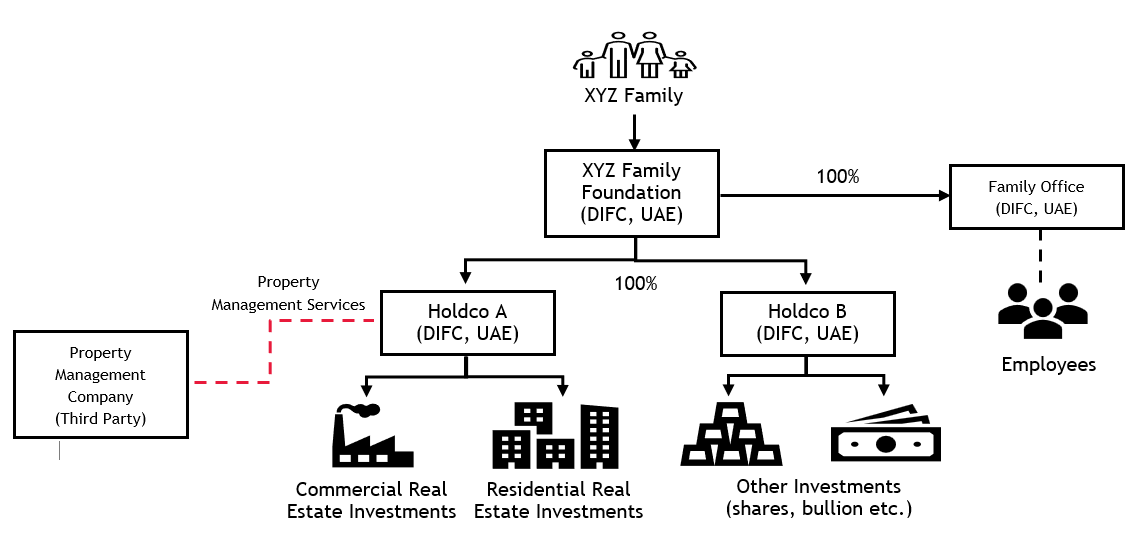
Case Study 4 : Family Foundation Structure
Background:
The XYZ family, which has built a diversified investment portfolio comprising real estate, bullion, shares, and other financial assets, is evaluating the establishment of a DIFC Family Foundation as part of its broader succession planning and wealth preservation strategy.Historically, these investments, including residential and commercial real estate holdings, were owned directly by individual family members in their personal capacities. As the family’s wealth has expanded across generations, the family now intends to centralise ownership and management of these assets through dedicated holding companies ultimately owned by the DIFC Foundation, XYZ Family Foundation.
The proposed structure is designed to enhance governance, streamline succession planning, safeguard family wealth, and ensure continuity in long-term asset management.
Under the proposed arrangement:
- HoldCo A and HoldCo B, incorporated as DIFC Prescribed Companies (i.e., Special Purpose Vehicles) with a licensed activity of "Holding Company," and wholly owned by the XYZ Family Foundation, will function exclusively as investment holding entities. These entities will not undertake any active commercial or operational business activities.
- HoldCo A shall engage a third-party property management company to manage the commercial and residential real estate properties held by it in exchange for a property management fee.
- XYZ Family Foundation plans to establish a Family Office as a Private Company in the DIFC. The Family Office will employ personnel and provide family office services to support the management of the family foundation’s investments.
UAE Corporate Tax Implications
Taxation of Family Foundation
Under the UAE Corporate Tax regime, a foundation, trust, or similar entity that is a juridical person may be subject to Corporate Tax like any other juridical person. However, where the entity satisfies certain prescribed conditions, it may qualify as a Family Foundation for Corporate Tax purposes.A qualifying Family Foundation may apply to the FTA to be treated as an Unincorporated Partnership i.e. fiscally transparent for Corporate Tax purposes.
Where a foundation is regarded as a fiscally transparent Family Foundation:
- The beneficiaries of the Family Foundation are deemed to be partners in an Unincorporated Partnership; and
- Each beneficiary is treated, for Corporate Tax purposes, as:
- conducting the activities of the Family Foundation;
- having the same status, intention, and purpose as the Family Foundation;
- holding the assets held by the Family Foundation; and
- being party to any arrangement to which the Family Foundation is a party.
Conditions to Qualify as a Family Foundation for Corporate Tax Purposes:
The following conditions must generally be satisfied for a foundation to qualify as a Family Foundation for Corporate Tax purposes:
- Beneficiary condition: It must be established for the benefit of natural persons or / and public benefit entities.
- Principal activity condition: The principal activity must be to receive, hold, invest, disburse, or otherwise manage assets or funds associated with savings or investment.
- No Business Activity condition: It must not conduct any activity that would have constituted a Business or Business Activity had such activity been undertaken directly by a natural person founder, settlor, or beneficiary.
- No Tax avoidance condition: The main or principal purpose of the Family Foundation must NOT be the avoidance of Corporate Tax.
- Distribution condition: Where beneficiaries include public benefit entities, the prescribed distribution conditions must also be satisfied.
Multi-Tier Structures
Under the UAE CT Law, a juridical person meeting specific conditions may also apply to be treated as a fiscally transparent Unincorporated Partnership.The eligibility of juridical persons within a multi-tier structure must be assessed separately for each entity. To qualify, the entity must:
- be directly or indirectly* 100% owned and controlled by a Family Foundation; and
- independently satisfy the ‘Family Foundation for Corporate Tax Purposes’ conditions outlined above.
Analysis of the XYZ Family Foundation Structure:
XYZ Family Foundation:Based on the facts provided, the XYZ Family Foundation appears to satisfy the conditions required to qualify as a Family Foundation for UAE CT purposes. The analysis is summarised below:
- Beneficiary condition: The foundation is established for the benefit of identifiable family members.
- Principal activity condition: The principal activity of the structure is to hold and manage the above investment assets.
- No Business Activity condition: The activities undertaken are investment-related in nature and do not appear to constitute active business activities.
- No Tax avoidance condition: The primary objectives of the structure are succession planning, governance enhancement, and long-term wealth preservation rather than tax avoidance.
- Distribution condition: Not applicable, as the beneficiaries consist solely of family members and non-public benefit entities.
HoldCo A and HoldCo B:
With respect to HoldCo A and HoldCo B, both entities are wholly owned and controlled by the XYZ Family Foundation and, subject to satisfying the Family Foundation conditions, may also qualify to be treated as fiscally transparent entities upon application to and approval by the FTA.Accordingly, subject to obtaining FTA approval, the income earned through the XYZ Family Foundation structure, including HoldCo A and HoldCo B, would generally be regarded as income earned directly by the beneficiaries ie family members.
As real estate investment income (such as rental income from residential and commercial real estate investments) and personal investment income (such as dividends and capital appreciation from shares, bullion, and other investments) are generally outside the scope of UAE Corporate Tax when earned by natural persons in a non-business capacity, such income derived through the XYZ Family Foundation structure would likewise generally remain outside the scope of UAE Corporate Tax.
Family Office:
With respect to the Family Office, the entity would be engaged in the business of providing family office services. Accordingly, even though it is wholly owned and controlled by the XYZ Family Foundation, it would not independently satisfy the Family Foundation conditions, specifically the "No Business Activity Condition." As such, the Family Office would be subject to UAE Corporate Tax at 9%, or 0% if eligible to avail free zone relief.Reflecting the growing demand for wealth preservation, succession planning and asset-holding structures, the DIFC foundation ecosystem expanded significantly, with the number of foundations reaching 1,409 as of H1 2026, a 67% increase year-on-year
DIFC as a Wealth and Fund Manager:
DIFC is MEASA's largest and deepest wealth & Asset Management related cluster. DIFC manages USD 450B to USD 700B in total wealth and assets under management (AUM).There are benefits available to the fund / wealth manager entity set-up in DIFC from UAE CT Law perspective.
UAE Corporate Tax Implications
Such services will be Qualifying Activities if the DIFC entity is appropriately regulated i.e. subject to the regulatory oversight of the Dubai Financial Services Authority and on satisfaction of prescribed conditions to be considered as QFZP under the UAE CT Law.Note: Scope of this article is limited to the tax considerations outlined above and does not extend to any licensing, regulatory, or other legal requirements that may apply to the relevant activities or structure. A separate review should be undertaken to assess any such requirements based on the specific facts and circumstances.