
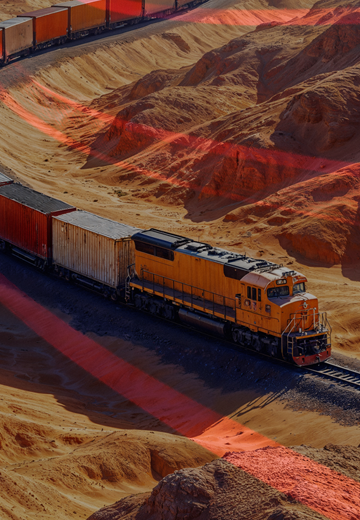
Continuing our three-part leadership series, this second instalment builds on the insights explored in the previous article, which examined how Etihad Rail is redefining connectivity and laying the foundation for the UAE’s next phase of economic growth. This article explores how businesses can translate that transformation into practical supply chain decisions before the rail network becomes fully operational.
As Etihad Rail expands beyond freight into passenger services, connecting 11 cities across the UAE and new cross-border and bonded rail corridors strengthen regional trade, organisations must rethink how they approach operations, investment and growth. From real estate and workforce strategy to supply chain design, tax, customs and free zone competitiveness, the network is set to reshape the way business is conducted across the region.
This three-part leadership series was developed under the leadership of Shivendra Jha, Partner and Head of Advisory Services and International Liaison Partner (ILP), with contributions from BDO UAE experts Aayush Bagaria, Senior Manager, Deal Advisory, Shamsuddeen Khader, Head of Business Services and Outsourcing and Ashish Athavale, Partner, Tax Advisory Services.
In this Part 2: Rethinking regional supply chains, Aayush Bagaria, Senior Manager – Deal Advisory at BDO UAE, explores how multinational companies should prepare their regional supply chains for the introduction of Etihad Rail. Aayush Bagaria examines why organisations should reassess distribution network design, inventory strategies, multimodal logistics, compliance readiness and supply chain resilience now, before long-term investments and operating models become locked into legacy logistics structures.
Supply chain restructuring before Etihad Rail: What decisions should multinational companies make now?
Aayush Bagaria, Senior Manager – Deal Advisory at BDO UAE, believes businesses should look beyond simply deciding whether they will use rail and instead reconsider the design of their entire regional supply chain."Once a logistics network has been established — warehouses, distribution centres, customs procedures, supplier contracts, ERP systems and transport agreements — it becomes extremely expensive to redesign. Etihad Rail provides an opportunity to rethink those models before they become embedded for another decade."
At BDO UAE, we believe the introduction of Etihad Rail is not simply a transportation project. It represents an opportunity for multinational organisations to reassess how their regional supply chains are designed. Companies that begin evaluating their operating models before rail becomes fully operational will be better positioned to improve efficiency, strengthen resilience and avoid becoming locked into legacy logistics models.
Why should companies redesign their regional distribution networks now?
Many multinational companies currently operate highly centralised distribution models, with one or two large distribution centres serving the wider GCC primarily through road transport."Rail introduces a new optimisation variable. Companies will need to reassess the optimal number, size and location of distribution centres by considering total landed cost, inventory positioning, transport lead times, customer service levels and resilience — not simply warehouse rent or trucking costs," Aayush Bagaria explains.
For some organisations, a centralised network may remain the most efficient model. For others, rail may support a hub-and-spoke approach or strategically located satellite distribution centres along major economic corridors.
As Aayush notes:
"The question shifts from 'Where is the cheapest warehouse?' to 'Where is the most efficient network?'"
How could Etihad Rail influence inventory and supply chain strategy?
Beyond transportation, rail has the potential to reshape inventory management strategies.Improved regional connectivity can reduce lead-time variability, allowing organisations to reassess safety-stock requirements, inventory buffers and replenishment policies. Over time, this may improve inventory turnover, reduce working capital requirements and enhance customer service levels.
"Supply chains increasingly compete on responsiveness rather than simply cost. For CFOs and finance teams, this becomes a balance-sheet discussion rather than just a logistics discussion," Aayush says.
Rather than focusing solely on transport savings, businesses should consider how improved network reliability can optimise inventory positioning across the region.
Why should businesses prepare for multimodal supply chains?
Historically, many GCC supply chains have been designed around a relatively straightforward sequence of port, truck and customer.Etihad Rail introduces the opportunity to integrate ports, rail terminals, trucking networks and, where appropriate, air cargo into a single multimodal transport system.
As Aayush Bagaria explains:
"The competitive advantage will come from selecting the most efficient transport mode for each leg of the supply chain rather than simply replacing trucks with trains."
Preparing for this transition requires organisations to review transport contracts, routing strategies, carrier relationships, warehouse interfaces and operational planning processes to ensure each transport mode complements the broader supply chain.
Why should compliance frameworks evolve alongside physical infrastructure?
Preparing for rail is not only about infrastructure — it also requires organisations to review the governance frameworks that support cross-border operations."Cross-border rail movements introduce new operational and compliance considerations, particularly as regional routes such as the UAE–Oman Hafeet Rail project become operational," Aayush explains.
Businesses should begin reviewing customs procedures, bonded logistics arrangements, free-zone operating models, VAT treatment, transfer pricing implications where relevant, digital documentation and governance frameworks well before freight volumes increase.
As Aayush notes:
"While physical infrastructure can be built relatively quickly, operational and compliance readiness often takes considerably longer. Compliance should not be treated as an afterthought — it needs to be designed into the future operating model from the outset."
Why is resilience becoming just as important as efficiency?
Recent geopolitical events, shipping disruptions and port congestion have demonstrated the importance of resilient supply chains. Rather than replacing one transport mode with another, rail provides organisations with an opportunity to diversify logistics options and reduce dependence on a single mode of transport.According to Aayush Bagaria:
"For multinational companies, resilience is now a board-level objective alongside cost optimisation. The strongest supply chains of the future will be the most adaptable, not necessarily the cheapest."
From BDO UAE's perspective, organisations that begin reassessing their regional operating models today will be better positioned to capture the full value of the UAE's next generation of logistics infrastructure.
As Aayush concludes:
"Many businesses are still making long-term decisions — including warehouse leases, distribution-centre investments and transport contracts — based on today's logistics landscape rather than tomorrow's. The organisations asking whether their regional network remains optimally configured, where inventory should be positioned in a multimodal environment and whether their operating model can adapt to evolving regional connectivity are far more likely to realise the full value of Etihad Rail."
Stay tuned for Part 3
The UAE's rail network is reshaping far more than transportation. As Aayush's perspective demonstrates, businesses should already be rethinking how their regional supply chains are designed—from distribution networks and inventory strategies to multimodal logistics and operational resilience.This article is the second in BDO UAE's three-part leadership series examining how the country's evolving rail infrastructure is transforming the business landscape.
Next in the series: Part 3: How the UAE's expanding rail network is reshaping VAT, Customs and the future competitiveness of free zones.
Follow BDO UAE on LinkedIn for the latest insights from our Advisory and Tax specialists as we examine the business, tax and strategic implications of the UAE's evolving rail network.
CONNECT WITH AN EXPERT